
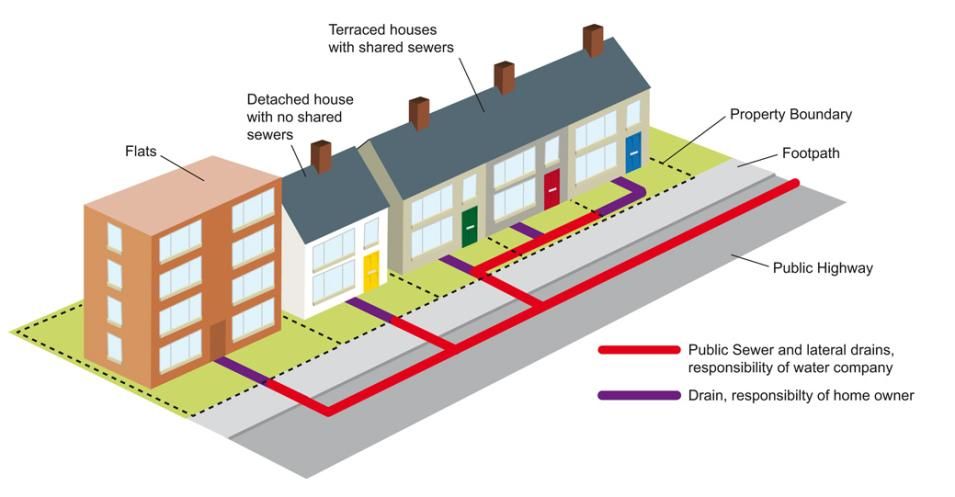
Our homes are connected to systems of drains and sewers, which function to carry away wastewater. If these pipes become blocked, we need to take steps to fix the issue and prevent ongoing problems. On encountering a blockage, what do you need to do and who is responsible for blocked drains?
Drain Responsibility at a Glance
| Drain / Sewer Type | Who Is Responsible | Who to Contact |
|---|---|---|
| Private drain inside your property boundary | You (the homeowner) or your landlord if rented | A private drainage contractor |
| Lateral drain (property boundary to public sewer) | Your local water company, in almost all cases | Your water company’s blockage line |
| Public sewer | Your local water company | Your water company’s blockage line |
| Shared drain connected to a public sewer | Your local water company (transferred since Oct 2011) | Your water company’s blockage line |
| Shared drain NOT connected to a public sewer (e.g. private sewer, off-mains) | Jointly, by all connected property owners | A private contractor, cost split between owners |
| Drains inside a block of flats | The freeholder or managing agent | Your managing agent / freeholder |
| Blocked road gully | Local council / highways authority | Your local council |
| Septic tank, cesspit, or sewage treatment plant (off-mains) | The property owner | A private contractor |
Drains on your property
Drains within the boundary of your property are considered private drains. If a drain on your property becomes blocked, then it’s your responsibility to unblock it. You can attempt to unblock the drain yourself, or you can call a professional drainage company to do this for you. Taking out insurance is also an option to pay for fixing a private drain.
Lateral drains and sewers
Lateral drains are located outside your property, generally underneath the road or pavement. Lateral drains are the pipes which function to carry wastewater away from your home and into a sewer. These are connected to your private drains, yet they are not considered your responsibility. Lateral drains are publicly owned.
Sewers function to collect the waste and water from the drains of several different properties. Most sewers are publicly owned; however, there are still some privately owned sewers. If you have a private sewer, you could be liable to fix it, and you will need to contact your local sewerage company to find out.
When a drain or sewer is outside the boundaries of your property, it is the responsibility of the water company to fix the problem, at no cost to you. If you believe that a blockage has occurred in a lateral drain or sewer, you should call your water company.
Blocked Drain Outside Your Property: Who Is Responsible?
If a blocked drain is outside your property boundary – under a road, pavement, or a shared driveway – responsibility usually shifts away from you and on to your local water company. This applies to lateral drains (the length of pipe that carries wastewater from your property to the public sewer) and to public sewers themselves, both of which are typically maintained free of charge by the water company. The main exception is if your home isn’t connected to the mains network, or if the pipework in question was never adopted by a water company, in which case responsibility stays with the property owner or owners. Because pipe runs don’t always follow the boundary line exactly, the safest way to confirm whether a blockage sits inside or outside your responsibility is a CCTV drain survey before you pay for or arrange any work.
How to Tell If a Blockage Is Inside or Outside Your Boundary
- Check where your manholes sit – a manhole near your boundary wall often marks the changeover point from private drain to lateral drain.
- Look at where the problem is showing up – gurgling or backing-up indoors usually means a private drain issue; overflowing manholes or gullies in the road point to a public asset.
- If in doubt, request a CCTV drain survey – it maps the pipe run and pinpoints the blockage location relative to your boundary, so you don’t pay for a repair that isn’t yours to fix.
- Contact your water company first if the issue is clearly outside your boundary – they will confirm ownership and, if it’s theirs, clear it at no cost to you.
Contacting Thames Water About a Blocked Drain
If you’re in the Thames Water region and suspect the blockage is in a public sewer or a lateral drain, you can report it directly to Thames Water on their 24-hour blockage line. They will investigate and, if the pipework falls within their responsibility, clear it free of charge. If it turns out not to be their asset, they’ll tell you at the time so you can arrange a private contractor instead.
Thames Water is not responsible for everything connected to your home. Specifically, they do not cover:
- Waste pipes above ground (e.g. visible pipework on the outside of a building).
- Drains between your property and the boundary that serve only your property – these remain the homeowner’s responsibility.
- Sewers or drains that serve multiple individual dwellings, such as blocks of flats – these are usually the responsibility of the freeholder or managing agent.
What to Expect When You Report a Blockage to Thames Water
- They will ask for your address and a description of the problem (smell, backing up, overflow location) before sending an engineer.
- If they attend and the blockage is on their asset, clearance is free – you won’t be charged.
- If the blockage is on your private pipework, they can sometimes still clear it for a fee, or you can instruct your own contractor – but if you go private without checking first, you can’t later claim the cost back from Thames Water.
- Tenants should also notify their landlord when reporting a blockage, since the landlord may be responsible for the private side of the system.
Shared Drains and Drains You Share With a Neighbour
If you have a drain that is shared with a neighbour, your local water company will be responsible for this drain. You will only be accountable for a private drain on your property that is not shared. For those who live in a block of flats, it is the management company who are liable for any repairs within the property boundary. The water company are again responsible for fixing the lateral drains that service the flats.
A shared drain is any pipe that carries wastewater from two or more properties before it reaches the public sewer. Since October 2011, most shared drains and lateral drains that connect to the public sewer network transferred from private ownership to the local water company, which is why the majority of shared-drain blockages today are handled and paid for by the water company rather than the households that use them.
The exception is properties that aren’t connected to a public sewer – for example, homes on a private sewer or off-mains drainage. In these cases, a shared drain remains the joint responsibility of every property connected to it, and the cost of clearing a blockage or carrying out repairs is normally split between the owners in proportion to use.
What If My Neighbour Won’t Pay for a Shared Drain Repair?
- Start by getting a CCTV drain survey – establishing exactly where the blockage is and what’s causing it removes ambiguity and often resolves disagreements about fault.
- Check any deeds, leases, or tenancy agreements – some properties have a formal easement or maintenance agreement setting out how shared drain costs should be split.
- Try to agree costs informally first – it’s almost always cheaper and faster than a dispute.
- If a neighbour refuses to engage and there’s a genuine health or hygiene risk, your local council’s environmental health department has powers to serve a legal notice requiring the responsible party to act.
Tenant or Landlord
Generally speaking, if you rent your property, then the landlord will be responsible for all of the maintenance and repairs, including the drains. Minor blockages in sinks or toilets can usually be fixed by the tenants themselves. With the use of plungers or drain cleaners, it should be straightforward to deal with these small incidents of blockage.
Maintaining your drain
You must adequately maintain any drains that you own; blockages, cracks, or misconnected pipes can damage your drain and the surrounding areas of your home. Dirty water can end up in our rivers if any pipes are incorrectly attached or faulty. The environmental health department can instruct you to carry out maintenance on private drains should they see a problem, but you should try to keep on top of these issues yourself.
When you are maintaining a private drain, you should look out for signs of minor issues. It’s preferable to spot any problems early before they get worse. You may notice, for instance, deterioration such as leaks, cracks, or eroding pipes. If you have a blockage, you may notice foul smells or that wastewater drains away slowly.
Private sewers
If your sewer is private and you own the property, then it is your responsibility to repair any blockages and to make the associated payments. If the private sewer is serving several properties, then all owners will be obligated to pay for the repairs. If you are unsure whether your sewer is public or private, you can check with your local sewerage company to get this information.
Connect to a public sewer
According to the Water Industry Act 1991, the owner of a private sewer is entitled to have their sewer or drains connected to a public sewer. The owner or occupier of a premises in general, can also apply to connect to a public sewer. If you wish to apply, you can do this via an application form with your local water supplier. Here is the application form for the supplier Thames Water.
Requesting a company to adopt your sewer
In 2010, the government stated that the majority of private sewers and lateral drains would soon have full ownership by sewerage companies. According to Thames Water, up to 10 million homeowners were previously responsible for private sewers, yet many did not realise this until there was an issue which they had to fix. As a repercussion of this, many private sewers were left in bad condition. These reasons informed the decision to transfer the ownership of private sewers; from individuals to sewerage companies.
Any lateral drains or private sewers that were connected to a public sewer before 1st July 2011, were transferred in ownership on 1st October 2011. If you still own a lateral drain or sewer, that remained unaffected by this legislation, you can request that your local sewerage company adopt it from you.
Off-mains drainage
When your property is in a rural location, you will likely have off- mains drainage. This type of drainage is a self-contained system connected to your property, or perhaps shared with your neighbours. There are three types of off-mains drainage; one is a cesspit, which is a holding tank that must be emptied approximately every eight weeks. Another is a septic tank; solid waste is kept in a tank and the liquid waste goes to a drainage field. Thirdly, sewage treatment plans involve compressed air that’s blown into a tank to break down waste. If you have a problem with any of these drainage systems you are responsible for the payments and repairs.
Further information on blocked drain responsibility
For further information on water and drainage services, you can look to Ofwat’s website. Ofwat is a water services regulation authority, responsible for the sewerage industry and the water sector. You can also take a look at the Water Industry Act if you would like to read more about water legislation, including the provision of sewerage services.
FAQ
Who is responsible for a blocked sewer drain?
If the sewer is a public one, your local water company is responsible for clearing blockages and carrying out repairs, usually at no cost to you. If you have a private sewer serving only your property (rare, and mostly in rural or off-mains areas), responsibility stays with the property owner.
Who is responsible for a blocked drain outside my property?
It depends on what the pipe is. If it’s a lateral drain or public sewer running under a road, pavement, or shared land beyond your boundary, your water company is responsible. If it’s still within your boundary – even if it’s outdoors, like a garden gully – it remains yours to fix.
Do I need to contact Thames Water for a blocked drain?
Only if the blockage is likely to be in a lateral drain, public sewer, or a shared drain that has transferred to their ownership. If the problem is clearly inside your home or on pipework that serves only your property, you should arrange a private drainage contractor instead.
What is Thames Water not responsible for?
Thames Water does not cover above-ground waste pipes, the section of drain between your property and the boundary that serves only your home, or drains and sewers serving multiple separate dwellings such as blocks of flats.
Who is responsible for a shared drain?
If the shared drain connects to the public sewer network, your water company has been responsible for it since a 2011 transfer of ownership. If it doesn’t connect to a public sewer, it remains the joint responsibility of every property that uses it.
What counts as shared drainage with a neighbour?
Any pipe carrying wastewater from your property and at least one other property before it joins the public sewer counts as a shared drain. This is common with terraced housing, semi-detached properties, and blocks of flats.
Who pays if a shared drain is blocked?
If the drain has transferred to the water company, clearing the blockage is free. If it hasn’t (because it’s not connected to a public sewer), the cost is normally split between the connected property owners.
What if my neighbour refuses to pay for a shared drain repair?
Try to agree costs informally first, and check your deeds or lease for any maintenance agreement. A CCTV survey can help settle disputes over fault. If there’s a genuine health risk and no cooperation, your council’s environmental health team can intervene.
Who is responsible for a blocked drain in a block of flats?
Drains within the building and serving only that block are usually the responsibility of the freeholder or managing company. Once the wastewater leaves the building’s boundary via a lateral drain, responsibility typically passes to the water company.
Is my landlord responsible for a blocked drain?
Generally yes – landlords are responsible for maintaining the structure and drainage of a rented property. Tenants are usually expected to deal with minor blockages caused by their own misuse, such as a sink clogged with food waste, but structural or persistent issues fall to the landlord.
How do I find out if a drain is public or private?
Your water company can usually tell you whether a specific drain or sewer has been adopted (public) based on your address. A CCTV drain survey can also trace the pipe run and identify the boundary point between private and public sections.
What happens if I ignore a blocked drain that isn’t mine to fix?
Even if a blockage isn’t your legal responsibility, leaving it unreported can lead to backing up, flooding, or odour problems affecting your property. Report it to the relevant party (your water company, council, or managing agent) as soon as you notice it, and keep a record in case of any dispute.
